Showing posts with label kong. Show all posts

Saturday, 28 July 2012

Leaving Your Dog Home Alone


Your new puppydog needs lots of attention (companionship, education, and play), but also to be taught how to entertain himself appropriately and how to thoroughly enjoy his time when left at home alone. Otherwise, a social vacuum can be a very lonely place.

Puppies and dogs predictably develop housesoiling, chewing, digging, and barking problems if allowed too much freedom and too little supervision and guidance during their first few weeks at home. Puppies and newly adopted dogs may become overdependent if allowed unrestricted access to their owners during the initial time in their new home. Overdependent dogs often become anxious when left at home alone, and they attempt to adapt to the boredom and stress of solitary confinement by busying themselves with doggy activities—chewing, digging, barking—which soon become owner-absent behavior problems. What else is there to do? Severely stressed dogs may work themselves up into a frenzy and spend the day circling, pacing, and panting.


A Special Place
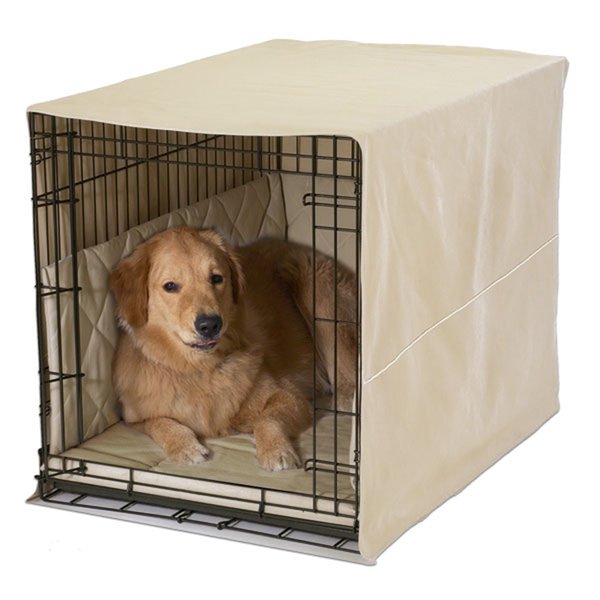
Dogs are den animals, and they value their own special place — a place for peaceful retreat, a methodical chew, or even a snooze. A doggy den (a collapsible and portable dog crate and dog bed) is an ideal training tool. Apart from its obvious uses for transporting dogs by car, train or plane, a crate may be used for short-term confinement when you cannot supervise your puppy—to keep him out of mischief and prevent him from making housesoiling, destructive chewing, and digging mistakes. In addition, the crate may be used specifically to create good household habits: to housetrain your puppy; to establish a hard-to-break chewtoy habit; to reduce excessive barking; to prevent inappropriate digging; and to foster confidence and calmness.
Right from the outset, when you are home, regularly confine your pup for "little quiet moments" in his dog crate in order to teach household manners and imbue confidence. Then your dog can look forward to enjoying a lifetime with the full run of your house, whether you are home or not.
Teach Your Puppy to Enjoy His Doggy Den
A dog crate is really no different than a child's crib, playpen, or bedroom. The first item on the agenda is to teach your puppy to thoroughly enjoy spending time in his doggy den. Stuff your puppy's first meal into a hollow chew-toy, tie the chewtoy inside the crate, and leave the door open so the pup may come and go as he pleases. Praise your puppy while he chews the chewtoy and supervise the puppy if he leaves the crate. Once the pup has settled down for a quiet chew, you may close the crate door. For your pup's second meal, put the stuffed chewtoys inside the crate and shut the door with the puppy on the outside. Once your puppy worries at the crate to get to his dinner, let the puppy enter his crate and close the door behind him. From now on, always give your puppy a stuffed chewtoy when confining him to his crate.

Teach Your Dog to Teach Herself
When at home, always confine your puppydog with a variety of hollow chewtoys stuffed with kibble and treats. Confining a dog to a crate with an attractive chewtoy is like confining a child to an empty room with a video game. This is called autoshaping. All you have to do is set up the situation, and your dog will automatically train herself. Each treat extricated from the chewtoy progressively reinforces chewing chewtoys and settling down calmly and quietly. Your dog will soon become hooked on her chewtoy-habit, leaving very little time for inappropriate chewing, digging, or barking. And if your puppydog is happily preoccupied chewing her chewtoy, she will fret less.
Your pup will soon learn that confinement is for a short time—and an enjoyable time.

Home-Alone Dogs 
Need An Occupation

Preparing dogs for inevitable periods of solitary 
confinement—and specifically teaching them
how to occupy their time when left at home alone—is the most pressing humane consideration for any new puppy in any household. Every dog requires some form of enjoyable occupational therapy. Vocational chewtoy chewing is the easiest and most enjoyable solution.
Dogs are crepuscular (most active at dawn and dusk), and so it is pretty easy to teach them how to calmly pass the time of day. During your puppydog's first few days and weeks at home, regularly confine him to a crate with stuffed chewtoys. Prepare the pup for your absence when you are present. When at home, it is possible to monitor your pup's behavior when confined for numerous short periods throughout the day. Your puppy's first impressions of an established daily routine create an acceptable and enjoyable status quo for years to come. Remember, once your puppy is confident, independent, and trained, he may enjoy free range of your house and garden for the rest of his life. 



To learn more, read Doctor Dunbar's Good Little Dog Book and our Home Alone booklet, available on-line from www.amazon.com.  Reprinted by www.dogstardaily.com with permission of Dr. Ian Dunbar and James & Kenneth Publishers, behavior blueprint by Dr. Ian Dunbar

Help My Dog's Chewing


Help My Dog's Chewing!


Chewing is essential for maintaining the health of your dog's teeth, jaws, and gums. Puppies especially have a strong need to chew to relieve the irritation and inflammation of teething. Dogs chew to relieve anxiety and boredom, as well as for entertainment. Your dog’s jaws are his tools for carrying objects and for investigating his surroundings. Essentially, a dog’s approach to all items in his environment is “Can I chew it?”


Chewing is Normal, Natural, and Necessary 


Dogs generally sleep at night and in the middle of the day. However, chewing is your dog’s primary form of entertainment during his morning and late afternoon activity peaks. After all, there are only so many things your dog can do when left at home alone. He can hardly read a novel, telephone friends, or watch the soaps! Indeed, most chewing sprees stem from your dog's relentless quest for some form of occupational therapy to pass the time of day when left at home alone or un-monitored.


Chewing is a perfectly normal, natural, and necessary canine behavior. Prevention and treatment of destructive chewing focus on management and education—to prevent your dog from chewing inappropriate items and to redirect your dog's natural chewing-urge to appropriate, acceptable, and resilient chew toys.


Prevent Destructive Chewing

When leaving home, confine your puppy or dog to a long-term confinement area, such as a single room or puppy play pen or crate —your puppy’s playroom—with a comfortable bed, a bowl of water, a doggy toilet (if not yet housetrained), and nothing to chew but half a dozen freshly-stuffed chewtoys. Housetrained adult dogs may be confined (with their chewtoys) to a dog crate. Your dog will happily settle down and entertain himself with his chewtoys as soon as you leave in the morning, and later he will be more inclined to search for chewtoys when he wakes up in anticipation of your afternoon return. This is important since most chewing activity occurs right after you leave home and right before you return. When you return, instruct your dog to fetch his chewtoys so you can extricate any liver or treats which he could not get out and give them to him. 


When you are home but cannot watch your puppy carefully, confine your puppy to her doggy den (crate) with nothing but a freshly-stuffed chewtoy for entertainment. Every hour on the hour (or at longer intervals with housetrained adult dogs), take your puppydog to her doggy toilet (see Housetraining), and if she goes, praise her and play some chewtoy games with her before putting her back in her crate with a freshly stuffed chewtoy.

The purpose of confinement is to prevent your dog from chewing inappropriate items around the house and to maximize the likelihood your dog will develop a chewtoy habit. If you can watch your dog carefully he or she does not need to be crated, if you need to answer the phone, have a shower etc be sure to put your puppy back in his/her doggy den. 

Redirect Chewing to Chewtoys

The confinement schedule described above optimizes self-training; your dog will train herself to chew chewtoys. In fact your dog will soon become a chewtoyaholic. With a good chewtoy habit, your puppy will no longer want to destroy carpets, curtains, couches, clothes, chair legs, computer disks, children's toys, or electrical cords. Your dog will be less likely to develop into a recreational barker. And also, your dog will happily settle down calmly and quietly and will no longer be bored or anxious when left alone.


You must also actively train your dog to want to chew chewtoys.
Offer praise and maybe a liver treat every time you notice your dog chewing chewtoys. Do not take chew toy chewing for granted. Let your dog know that you strongly approve of her newly acquired, appropriate, and acceptable hobby. Play chewtoy games with your dog, such as fetch, search, and tug-of-war.


Chewtoys should be indestructible and nonconsumable. Consumption of non-food items is decidedly dangerous for your dog's health. Also, destruction of chewtoys necessitates their regular replacement, which can be expensive. However, compared with the cost of reupholstering just one couch, £50 worth of chewtoys seems a pretty wise investment.


Kongs, Tuff Toys, Biscuit Balls, Big Kahuna footballs, and sterilized long-bones are by far the best chewtoys. They are made of natural products, are hollow, and may be stuffed with food to entice your dog to chew them exclusively. To prevent your dog from porking out, ensure that you only stuff chewtoys with part of your dog's daily diet (kibble or raw food) with a few nuggets of really yummy treats for him to be surprised by. Firmly squish a piece of liver in the small hole in the Kong, fill the rest of the cavity with moistened kibble and a few yummy treats, and then put the Kongs in the freezer. Voila, Kongsicles! As the kibble thaws, some falls out easily to reinforce your dog as soon as she shows interest. Other bits of kibble come out only after your dog has worried at the Kong for several minutes, thus reinforcing your dog's chewing over time. The liver is the best part. Your dog may smell the liver, see the liver, (and maybe even talk to the liver), but she cannot get it out. And so your dog will continue to gnaw contentedly at the Kong until she falls asleep.
Until your dog is fully chewtoy-trained, do not feed her from a bowl. Instead, feed all kibble, canned food, and raw diets from chewtoys, or handfeed meals as rewards when you notice your dog is chewing a chew toy. 


Here is a great video on stuffing Kongs: 


Here is my video on being prepared for puppies, bored teenage dogs and adult chewers:


To learn more, read Doctor Dunbar's Good Little Dog Book and our Chewing booklet, available on-line from www.amazon.com.  Reprinted by www.dogstardaily.com with permission of Dr. Ian Dunbar and James & Kenneth Publishers, behavior blueprint by Dr. Ian Dunbar


Sunday, 4 March 2012

Teaching Puppies How To Play


PLAY SCHOOL!

Teaching your puppy appropriate play with humans

 Playing with your puppy is essential!  It builds your relationship with him, teaches him control and is fun!  However, puppies have sharp teeth, so play needs to be safe.


Follow the guidelines below to ensure that your dog plays by the rules!


1.Always use a toy!  It’s unacceptable to allow your puppy to mouth your hands, clothes or hair or to wrestle on the floor – this is basically teaching your puppy to bite people when anyone plays with the puppy (for more information on this see "puppy biting and bite inhabition") . Use a long rug boy, a ball on a rope or other boy that keeps your hands well away from your dog’s mouth. 

2. Teach your puppy to tug by holding the toy LOW TO THE GROUND and moving it as if it were a snake along the floor.  Allow your pup to chase the toy, then pounce on it and grab it.  Have a gentle tug game!  It’s OK for your puppy to rug and growl – it just means he’s enjoying himself!

3. Now teach your puppy to drop the toy when you ask.  After a tug game, keep your hand on the toy, but don’t put any pressure against it.  Now offer your puppy a really tasty titbit so eat.  It’s impossible for him to keep the toy in his mouth and eat the food as, so as soon as he drops the toy, say “Good” and let him eat the food.  KEEP THE TOY WHERE IT IS!  As soon as your pup has eaten the food, play again and repeat the routine.  After three or four repetitions, most pups are dropping the toy voluntarily when they see the food coming.  As soon as this starts to happen, say “Drop” or “Give” very quietly, just before your pup let’s go.  This then leads to your pup dropping the toy instantly on one quiet command!  At this point, you can just use the food as a reward from time to time, as being allowed to carry on playing is a reward in itself.

4. Your pup must abide by the golden rules of play.  If he so much as touches your hand or skin with his teeth while playing, you say “Too bad” and the game finishes that instant!  Your whole family need to be consistent with this!


Teach your puppy to play by himself

Puppies need to learn to play by themselves so that they can be occupied when you are busy or need to go out.  Chew toys are best for this. Kongs or hollow toys that can be filled with food are perfect as they reward the puppy for playing at the same time as keeping him busy!

However, old cardboard boxes, and safe, empty plastic water bottles make great playthings for active pups which need novelty and stimulation.


This video shows how to teach any dog of any age how to use a Kong toy:


This video shows how in expensive items can be made in to interactive toys: