Showing posts with label control. Show all posts

Tuesday, 2 April 2013

Attacking The Vacuum Cleaner??


Improving your dogs behavior around the vacuum cleaner.
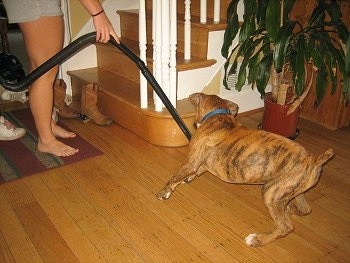


First Thing, keep taking him out if you need to hoover unless you are training him (popping the dog in the car also tends to work). The more he growls and barks at the hoover the more ingrained the habit becomes and the more he will hate the hoover. 

Stage One:

Have the hoover off and still and simply treat him for looking at it or touching it but this should be done under his free will and the treats thrown away from the hoover. 
You can mark him looking at the hoover with "yes" or with a click (using a clicker - if ned be we can show you these stages in a one to one) 
When he is comfortable with the hoover in the room and is not jumping or avoiding it you can move on to stage two.

Stage Two:

Put the hoover in the furthest room from where you are training and turn it on. Shut all the doors so the sound is muffled. Mark each time he looks towards where the noise is coming from with a "yes"
When he seems very happy and comfortable you change the room where the sound is coming from and repeat. Remember you do not want him to see the hoover, even when you are moving it from room to room. 

Stage Three: 

Open the door to the furthest room and have the hoover on, same method reward him for looking but throw the treat away from where the hoover is (this needs to be the biggest distance in your house. You may also want to do these exercises on lead to prevent him rushing at the hoover. If at any stage he barks, growls or lunges however you have moved through the stages too quick. Don't forget to use amazing AAA+++ treats only the best will do and human food is normally the best!! 

Stage Four: 

Advance the game “look at the hoover” you are trying to get him closer and closer to the stationary but turned on hoover but without him showing any signs of stress or worry. It should be a game and he should be happy at all stages.  

Stage Five:

Now move him right away from the Hoover and turn it off, have some one else move it as if very very slowly hoovering and repeat the look at the hoover eat a treat game. Slowly move closer again. 

Stage Six:

Build up the speed of the turned off hoover until he will tolerate it being moved about in a normal hoovering fashion.

Stage Seven:

More right away again but now turn it on - repeat all the above steps. 

Stage Eight:

Now he should feel much better about the hoover but as a rule always pop him in another room with a lovely chew or bone to eat when you are hoovering. He is obviously frightened of it and whilst he should now feel better why make him tolerate something which he is so uncomfortable about? 

This should take about a month to achieve with very short daily sessions :) 

If you would like a one to one to combat this however please don't hesitate to ask. 

Sunday, 18 November 2012

Why don't clients see improvements with behavioural modification plans?

There is a common statement that clients will often make in their first consultation or I will over hear at shows, in pet shops and at the park etc that "nothing has worked for their dog". That their behaviour could not be changed or that the training they were given was incorrect, of a low standard, their dog is too naughty or doesn't listen.

Whilst there are some behaviours that are very hard to change, all behaviours can be altered in some way to some extent. These changes are very possible but they require a few things from the people training them.

  • A desire to change the behaviour in their dog that is strong enough that they will change their own lifestyle and routines and of course the ability for the owner to do this. 
  • A dedication to changing the behaviour that will last as long as the dog lives.
  • Hard work and practise.  

Whenever you try to change behaviour it takes time, regular practise and the dedication to keep practising for as long as it takes. In some cases this will be forever.

Having recently embarked on training my dog a new discipline that I have never before attempted and also making the decision that in order to do this I will need to get fit it has really been made clear to me why so many people fail to change their dogs behaviours to the extent they desire.

Training to get fit takes real dedication, committing to regular exercise, forever. Pushing yourself harder and possibly changing your routines and diet to fit with your new way of life. Without this you will not get fit, or you will get a degree of fitness but not what you could ultimately achieve. Of course there is also the fact that if you stop training you will again become unfit.

Training a dog to perform the required behaviours really well also takes all these things. The bigger change you require the more dedication it will take. The things that are required are:

  • Real dedication to run through training exercises and situational training every day. 
  • To train in alternative and new behaviour that is incompatible with the behaviour you want to change or stop. To keep that behaviour strong by practising it every day.
  • To proof the new behaviours so the dog will do them regardless of how hard the situation they find themselves in or what ever distractions are thrown at them.  
  • To be ready change personal routines and those of your dog, your expectations for your life with the dog (i.e. that it wont be the easy ride you had anticipated), to realise that the changes you make and the training you commit to will be life long.
In short many people do not or cannot dedicate enough resources to altering their dogs behaviours and thus do not make the improvements they seek. Whilst the right advice and coaching cannot be ignored, it is only effective if the advice and techniques are followed and more importantly practised. 

A great trainer will guide a client through these processes, explaining what is required, talking about how to make changes, what solutions are possible. Teach the client how to train the dog so they can practise, teach the client coping mechanisms for when things don't go to plan. Showing the client how to build on successes and improve the behaviour all the time till the client feels safe, happy and in control.  Make sure they motivate and inspire their clients to keep going because the persistence of trying with the right techniques and support is essential. 

Sunday, 5 August 2012

Don't Jump on My Guests or Me!

Teaching your dog not to jump up is about being consistent. I regularly see people telling their dogs to get off or down - the main problem is that this gives the dog attention every-time they jump - reinforcing the behaviour. Ignoring jumping can be really difficult as jumping up often hurts or can really knock the person the dog is jumping at.

DID YOU KNOW? - If you randomly reward a behaviour it becomes stronger than if you reward it all the time. Thats why jumping up, counter surfing and begging are so hard to break ... someone in the dogs life is 'sometimes' rewarding the behaviour. Thus randomly rewarding it - making it stronger still.

In this Video Emily Larlham shows you how to train the dog not to jump in the first place by rewarding the dog quickly and regularly for having four feet on the floor. She also puts the treat on the floor to stop the dog looking up for the reward.

Pay attention to the need to reward BEFORE the dog has jumped. This means you always need to be prepared whist teaching it, have treats ready in places around the house, by the front door inside and out, and always on your person when out and about. Remember keep some rewards up occasionally once trained (thus randomly rewarding this new feet on the floor behaviour, making it stronger!!).

When you don't have time or effort to train the dog don't allow them to jump at people by having them on the lead and standing far enough away your dog cannot make contact with people should he jump. Make sure people do not speak to him if he is leaping about on the lead. You can also put him in his crate or another room or garden if you have people round and you don't feel like training him the whole time. Sometimes you will also have guests of a certain type and it is not appropriate to train the dog with them there.


Saturday, 28 July 2012

Digging Doggies!


Dogs Don’t See Your Problem


Dogs consider digging to be a perfectly normal and natural doggy activity. In fact, terriers consider digging to be their very reason for being. It would therefore be fruitless to try to stop your dog from digging altogether. Prevention and treatment of misplaced digging focus on management and education: preventing your dog from digging in inappropriate areas and redirecting your dog's natural digging-desire to a suitable area.


Prevent Digging in Your Absence
When you are away from home, keep your dog indoors. When you are at home, try your best to accompany your dog outdoors to supervise and teach garden rules.Housesoiling, destructive chewing, and hyperactivity are the most common reasons why dogs are relegated to unsupervised, solitary confinement in the garden, where they predictably learn to bark, dig, and escape, and become over-excited whenever let indoors.


Digging for Freedom or Boredom 

Some dogs dig to escape because they cannot bear the boredom and anxiety of solitary confinement in the garden. Escaping is exceedingly dangerous for your dog's health. So if you decide to leave your dog in the garden, make the garden more interesting and be sure to fix the fence. Also make sure your dog has a cool resting place in the summer and warmth in the winter. Teach your dog to dissipate digging energy with other activities. Make sure your dog is well exercised (psychologically as well as physically) and entertained, and thus has no need to dig to escape from the garden. Teach recreational diggers to become recreational chewers. If your dog is busying himself with a chewtoy, he has little time to dig. Consequently, chewtoys stuffed with breakfast kibble are the best objects to leave indoors, or to bury in your dog’s digging pit. You must teach your dog how to entertain himself outdoors. This means your dog needs chewtoys outside, too.

Redirect Digging to a Digging Pit
Since you consider your dog’s choice of digging locations to be inappropriate, choose a location to your liking and teach your dog to dig there. Build your dog a digging pit (much like a child’s sandbox) in a suitable corner of the garden.Bury a meaty bone in your dog's digging pit. Your little doggie will be utterly delighted when she finds a huge meaty bone. Now, this single simple procedure may not totally prevent holes in other areas of the garden, but your dog will now be much more inclined to dig in her digging pit. Every morning, fill several chewtoys with your dog’s breakfast kibble and bury them in her digging pit. Your dog will discover that the digging pit is a virtual treasure trove where she can find toys for sustenance and entertainment.

Garden Rules
Once the dog's digging activities have been redirected to a suitable location in your garden, you might consider protecting other parts of the garden. Lay down chicken wire or chain-link fencing over the lawn and flower beds, add plenty of topsoil, and reseed.
Use boundary fences to partition the garden into doggy and non-doggy zones. The fences are not meant to be dog proof; rather, they are used as training aids to clearly demarcate lawn and garden boundaries to help you teach the rules. Always try to accompany your dog when he goes outside, especially during puppyhood or the first few months an older dog is at home. Remember, an owner in the garden is worth two in front of the television! It is not fair to keep garden rules a secret from your dog and then get angry with the dog for breaking rules he didn’t even know existed. Encourage and praise your dog for walking on paths and for lying down in dog zones. Tie a number of stuffed chewtoys to ground stakes or hang them from tree branches in dog zones to encourage your dog to want to spend time in those areas. Discourage your dog from entering non-doggy zones.


To learn more, read Doctor Dunbar's Good Little Dog Book and our Digging booklet, available on-line from www.amazon.com.  Reprinted by www.dogstardaily.com with permission of Dr. Ian Dunbar and James & Kenneth Publishers, behavior blueprint by Dr. Ian Dunbar


Sunday, 4 March 2012

Teaching Puppies How To Play


PLAY SCHOOL!

Teaching your puppy appropriate play with humans

 Playing with your puppy is essential!  It builds your relationship with him, teaches him control and is fun!  However, puppies have sharp teeth, so play needs to be safe.


Follow the guidelines below to ensure that your dog plays by the rules!


1.Always use a toy!  It’s unacceptable to allow your puppy to mouth your hands, clothes or hair or to wrestle on the floor – this is basically teaching your puppy to bite people when anyone plays with the puppy (for more information on this see "puppy biting and bite inhabition") . Use a long rug boy, a ball on a rope or other boy that keeps your hands well away from your dog’s mouth. 

2. Teach your puppy to tug by holding the toy LOW TO THE GROUND and moving it as if it were a snake along the floor.  Allow your pup to chase the toy, then pounce on it and grab it.  Have a gentle tug game!  It’s OK for your puppy to rug and growl – it just means he’s enjoying himself!

3. Now teach your puppy to drop the toy when you ask.  After a tug game, keep your hand on the toy, but don’t put any pressure against it.  Now offer your puppy a really tasty titbit so eat.  It’s impossible for him to keep the toy in his mouth and eat the food as, so as soon as he drops the toy, say “Good” and let him eat the food.  KEEP THE TOY WHERE IT IS!  As soon as your pup has eaten the food, play again and repeat the routine.  After three or four repetitions, most pups are dropping the toy voluntarily when they see the food coming.  As soon as this starts to happen, say “Drop” or “Give” very quietly, just before your pup let’s go.  This then leads to your pup dropping the toy instantly on one quiet command!  At this point, you can just use the food as a reward from time to time, as being allowed to carry on playing is a reward in itself.

4. Your pup must abide by the golden rules of play.  If he so much as touches your hand or skin with his teeth while playing, you say “Too bad” and the game finishes that instant!  Your whole family need to be consistent with this!


Teach your puppy to play by himself

Puppies need to learn to play by themselves so that they can be occupied when you are busy or need to go out.  Chew toys are best for this. Kongs or hollow toys that can be filled with food are perfect as they reward the puppy for playing at the same time as keeping him busy!

However, old cardboard boxes, and safe, empty plastic water bottles make great playthings for active pups which need novelty and stimulation.


This video shows how to teach any dog of any age how to use a Kong toy:


This video shows how in expensive items can be made in to interactive toys: