Showing posts with label positive. Show all posts

Saturday, 28 July 2012

Digging Doggies!


Dogs Don’t See Your Problem


Dogs consider digging to be a perfectly normal and natural doggy activity. In fact, terriers consider digging to be their very reason for being. It would therefore be fruitless to try to stop your dog from digging altogether. Prevention and treatment of misplaced digging focus on management and education: preventing your dog from digging in inappropriate areas and redirecting your dog's natural digging-desire to a suitable area.


Prevent Digging in Your Absence
When you are away from home, keep your dog indoors. When you are at home, try your best to accompany your dog outdoors to supervise and teach garden rules.Housesoiling, destructive chewing, and hyperactivity are the most common reasons why dogs are relegated to unsupervised, solitary confinement in the garden, where they predictably learn to bark, dig, and escape, and become over-excited whenever let indoors.


Digging for Freedom or Boredom 

Some dogs dig to escape because they cannot bear the boredom and anxiety of solitary confinement in the garden. Escaping is exceedingly dangerous for your dog's health. So if you decide to leave your dog in the garden, make the garden more interesting and be sure to fix the fence. Also make sure your dog has a cool resting place in the summer and warmth in the winter. Teach your dog to dissipate digging energy with other activities. Make sure your dog is well exercised (psychologically as well as physically) and entertained, and thus has no need to dig to escape from the garden. Teach recreational diggers to become recreational chewers. If your dog is busying himself with a chewtoy, he has little time to dig. Consequently, chewtoys stuffed with breakfast kibble are the best objects to leave indoors, or to bury in your dog’s digging pit. You must teach your dog how to entertain himself outdoors. This means your dog needs chewtoys outside, too.

Redirect Digging to a Digging Pit
Since you consider your dog’s choice of digging locations to be inappropriate, choose a location to your liking and teach your dog to dig there. Build your dog a digging pit (much like a child’s sandbox) in a suitable corner of the garden.Bury a meaty bone in your dog's digging pit. Your little doggie will be utterly delighted when she finds a huge meaty bone. Now, this single simple procedure may not totally prevent holes in other areas of the garden, but your dog will now be much more inclined to dig in her digging pit. Every morning, fill several chewtoys with your dog’s breakfast kibble and bury them in her digging pit. Your dog will discover that the digging pit is a virtual treasure trove where she can find toys for sustenance and entertainment.

Garden Rules
Once the dog's digging activities have been redirected to a suitable location in your garden, you might consider protecting other parts of the garden. Lay down chicken wire or chain-link fencing over the lawn and flower beds, add plenty of topsoil, and reseed.
Use boundary fences to partition the garden into doggy and non-doggy zones. The fences are not meant to be dog proof; rather, they are used as training aids to clearly demarcate lawn and garden boundaries to help you teach the rules. Always try to accompany your dog when he goes outside, especially during puppyhood or the first few months an older dog is at home. Remember, an owner in the garden is worth two in front of the television! It is not fair to keep garden rules a secret from your dog and then get angry with the dog for breaking rules he didn’t even know existed. Encourage and praise your dog for walking on paths and for lying down in dog zones. Tie a number of stuffed chewtoys to ground stakes or hang them from tree branches in dog zones to encourage your dog to want to spend time in those areas. Discourage your dog from entering non-doggy zones.



To learn more, read Doctor Dunbar's Good Little Dog Book and our Digging booklet, available on-line from www.amazon.com.  Reprinted by www.dogstardaily.com with permission of Dr. Ian Dunbar and James & Kenneth Publishers, behavior blueprint by Dr. Ian Dunbar


Sunday, 4 March 2012

Why has training not worked for your reactive dog ?

Why has training not worked for your reactive dog ?

There are lots of reasons why our dogs might be slow to respond to training or behavioural modification. By incorporating the tips and training methods found in this blog and from the trainers at Sussex County Dog Training your dogs behaviour can improve. Your daily interactions with your dog and your dogs interactions with the world around them will become as you understand your dog more and are able to better shape your dogs behaviour.
There are several barriers to improving your dog’s behaviour these include:
Using the wrong methods - to improve a behaviour on a permanent basis the root cause of the behaviour must be addressed. If the diagnosis of the cause is incorrect or training is simply addressing the symptoms then the real cause will go unresolved and the behaviour problem will continue. Common incorrect diagnosis often include dominance, guarding the owner and being a "bad" dog. Finding out why the dog is behaving in a certain way is step one, identifying the reward to the dog (the dogs reinforcement for performing the behaviour) is step two. Once we have done this we can look at how to reduce or prevent the dogs reinforcement and use appropriate methods to treat the dogs behaviour based on the root cause (such as fear).

Lack of Practice – our dogs may need more practice to become fluent. Dogs need far more practice than most of us realize to really ‘get it’. And, they need to be trained in a variety of environments with a variety of distractions before they understand how to apply knowledge to any situation, this is called generalization.

Lack of Relevance – our dogs can question the relevance of our requests. We need to help them understand that our requests have meaning and consequences to the dog. This may be that a word that means reward or a behaviour that leads to a consequence.
   
Punishment - our dogs may have been consistently punished when s/he behaved in a set way. A good example of this is when your dog barks at someone we punish the dog with a lead jerk and a firm “NO” – if the dogs outburst was caused by fear we have paired an aversive or negative feeling with the person the dog had barked at –not improving but damaging the dogs expectations of future encounters with people. Even if the dog stopped barking it has probably only suppressed its feelings rather than learnt not to do it in the first place. Be aware that using "training" tools which also punish the dog such as check chains, prong collars, citronella collars and electric or e collars will also suppress the behaviour of a dog without curing it. They can cause further mental and physical damage to the dog and carry a heavy negative moral burden.

Lack of Focus– our dogs may not be focused on us enough to hear our requests. They may be under too much stress, suffering from sensory over load or worried about what is going to happen next.

Lack of Impulse Control – our dogs may not have learned how to control their impulses (or self control) around certain distractions yet. If we can improve impulse control we can often reduce reactivity.

Operant and Classical Conditioning


Operant and Classical Conditioning


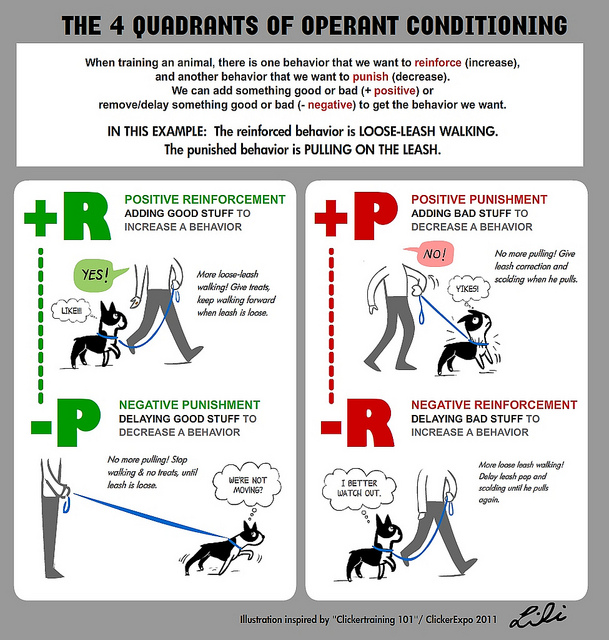
Operant conditioning is a defined set of principles, developed in the 1930’s by a behavioural scientist called B.F. Skinner. The theory says we can make things happen, either good or bad, by choosing behaviours that are either rewarded or punished. We use the 4 methods Positive Reinforcement, Positive Punishment, Negative Reinforcement and Negative Punishment and where the dog acts upon the environment. Dogs will not generalise well, here, and need to be trained in all different environments in order to fully understand what is required. Once they have learned the behaviour, in the front room, we then need to train that behaviour in the garden, then in the park, and so on, until the behaviour has become generalised. E.g. the dog learns that they can make good things happen by offering the sitting behaviour. Next the dog needs to learn that those good things still happen if the sitting behaviour is performed elsewhere. We are using the Positive reinforcement quadrant here to teach the dog that sit is the behaviour we want, and we want it, to cue, in all environments.

With Classical Conditioning, we are not necessarily looking to train a behaviour, yet looking for an emotional response from our dog.  Often our dogs have learnt these responses from a single incident, and thus these become generalised very quickly. Behaviours that involve a strong emotional response where the environment acts upon the dog are classically conditioned. i.e. fear of thunder and lightning or the fear of children after an incident involving a child pulling his/her ears. Next time he/she see’s a child, they can generalise very quickly and have an emotional response of fear towards children. On the other hand, as with Pavlov’s dogs, the emotional response to the bell ringing was to salivate at the prospect of food, and dogs who have had pleasant experiences with children, soon generalise that all children are nice, and their emotional response is one of happy thoughts and not fear.


When looking to apply operant conditioning or classical conditioning when dealing with a dog’s problem, first we must define the problem. Problems are often defined as problems for the owners and not for the dogs. A dog that loves to greet us by jumping up, may have been rewarded for this by a cuddle here and there, and yet now it has become a problem, especially as the dog has grown bigger and stronger. Here we would teach the dog a new behaviour (operant conditioning) as jumping up is not necessarily an emotional response (classically conditioned) but a learnt one, probably through reward.

We would in this case use positive reinforcement, and maybe, negative punishment to change the unwanted behaviour of jumping up to the desired one of sitting when you greet me.

When the dog jumps up we can turn away (negative punishment) and when the dog puts all 4 feet on the floor, we reward that behaviour (positive reinforcement) As we continue to do this exercise, the unwanted behaviour will extinguish, and the desired behaviour increase.

Alternatively, if we do not want to use negative punishment here, we can ask the dog for an incompatible behaviour to jumping up (desensitisation of incompatible behaviours), a sit, and reward this desired behaviour. Again the unwanted behaviour will eventually extinguish and the desired behaviour increase.

If we were to encounter a dog who would bark at another dog, due to an emotional response of fear (classically conditioned), we could look to change the dogs emotional response using classical conditioning, or a technique called counter conditioning.

For dogs to learn, we must ensure that they are in the right state of mind, and a dog that is so fearful may not be able to learn, as its emotions are such that it is not cognitive to learning. This happens if we subject the dog to too much of the stimuli that causes the fear in the first place. Some trainers will flood the dog here in an attempt to prove to the dog that there is nothing to fear and subsequently change the dogs emotional response and learn to be happier in the presence of other dogs. This method, in my opinion, can also cause a dog to shut down and not be able to learn that other dogs are nothing to be fearful of, or worse still lead to some aggression towards the other dogs. If we ensure that the dog is in a clam state before we introduce the stimuli, then this helps towards learning. We need to change the dogs emotional response from fear by adding something nice in the presence of the stimuli. We can use high quality treats to feed the dog, ensuring that our dog is not overly stressed at each stage. We will keep the stimuli(other dog) at a distance, where our dog is happily eating the treats, thus now pairing the presence of another dog with something nice. We can move the stimuli closer over a period of time or over different sessions, as our dog becomes more at ease, subsequently classically conditioning the dog to enjoy the presence of other dogs.
 

Jeff Sasse (2010)


4 Quadrants of Operant Conditioning


Positive Reinforcement – We increase the chance of a desired behaviour happening again by rewarding it. The dog soon learns that in order to earn his reward, he just has to repeat that desired behaviour.

E.g. when the dog sits in front of us, we say “yes” in a happy tone and reward that with a treat. Marking the behaviour with a “yes” and rewarding the dog with a treat will increase the chances of that behaviour happening again. This is a strong way to enhance the bond/relationship with your dog whilst training. Rewarding all the desired behaviours is a great way to help you and your dog feel great about training, and increases the desire to train and learn new things. When we use positive reinforcement dogs learn to think more and look to offer us behaviours in order to be rewarded. This gives the dog confidence in the learning program.

Positive Punishment – We decrease the chance of an undesirable behaviour happening again by adding a punishment that the dog dislikes (an aversive). The dog learns that if he repeats this behaviour, it may be paired with an aversive.

E.g. the dog Jumps up at us, so we smack it on the end of the nose!! The dog learns that if he jumps up at us, this may be paired with a smack on the nose, and so decides against jumping up.

This method of training, will eventually break down the bond/relationship between dog and handler and if used regularly will not only stop the dog enjoying training, but may, if the dog becomes fearful lead to aggression. Dogs may become tolerant of this method, making it ineffective in changing the behaviour, yet still affecting your relationship. Unlike positive reinforcement, dogs here learn not to trust their handler, and look to suppress behaviours in case a punishment was to follow.


Negative Reinforcement – The dog’s behaviour makes something undesirable go away.

E.g. in order to increase the chances of a sit, we lift the lead, choking the dog, and remove when sitting. The dog will sit because he doesn’t like the choking when lifting the lead. Like the punishment method dogs just want bad stuff to go away. They will however pair you with the “bad Stuff” and this will break down the bond/relationship you have with them.

Negative Punishment – We decrease the chances of an undesirable behaviour happening again by removing a motivator (something the dog wants)

E.g. the dog jumps up to get our attention (something the dog wants), so we turn our back (removing ourselves) in order to reduce the behaviour happening again. This type of punishment is a non-force method and can include removal of a treat, a toy, a person or even a privilege. This is a non-aversive method of providing a consequence for an unwanted behaviour. This type of punishment is best paired with positive reinforcement, which quickly teaches the dog rights and wrongs. In the example above, if we rewarded the sit on the floor with a treat or our attention (positive reinforcement) then we would not only look to extinguish the unwanted jumping up, but also increase the chances of the sit on the floor.
 
Jeff Sasse (2010)