Showing posts with label calm. Show all posts

Tuesday, 2 April 2013

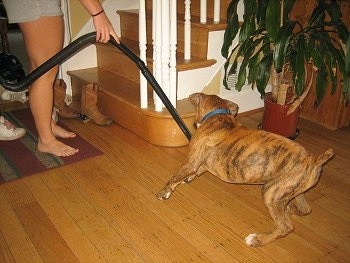
Attacking The Vacuum Cleaner??


Improving your dogs behavior around the vacuum cleaner.


First Thing, keep taking him out if you need to hoover unless you are training him (popping the dog in the car also tends to work). The more he growls and barks at the hoover the more ingrained the habit becomes and the more he will hate the hoover. 

Stage One:

Have the hoover off and still and simply treat him for looking at it or touching it but this should be done under his free will and the treats thrown away from the hoover. 
You can mark him looking at the hoover with "yes" or with a click (using a clicker - if ned be we can show you these stages in a one to one) 
When he is comfortable with the hoover in the room and is not jumping or avoiding it you can move on to stage two.

Stage Two:

Put the hoover in the furthest room from where you are training and turn it on. Shut all the doors so the sound is muffled. Mark each time he looks towards where the noise is coming from with a "yes"
When he seems very happy and comfortable you change the room where the sound is coming from and repeat. Remember you do not want him to see the hoover, even when you are moving it from room to room. 

Stage Three: 

Open the door to the furthest room and have the hoover on, same method reward him for looking but throw the treat away from where the hoover is (this needs to be the biggest distance in your house. You may also want to do these exercises on lead to prevent him rushing at the hoover. If at any stage he barks, growls or lunges however you have moved through the stages too quick. Don't forget to use amazing AAA+++ treats only the best will do and human food is normally the best!! 

Stage Four: 

Advance the game “look at the hoover” you are trying to get him closer and closer to the stationary but turned on hoover but without him showing any signs of stress or worry. It should be a game and he should be happy at all stages.  

Stage Five:

Now move him right away from the Hoover and turn it off, have some one else move it as if very very slowly hoovering and repeat the look at the hoover eat a treat game. Slowly move closer again. 

Stage Six:

Build up the speed of the turned off hoover until he will tolerate it being moved about in a normal hoovering fashion.

Stage Seven:

More right away again but now turn it on - repeat all the above steps. 

Stage Eight:

Now he should feel much better about the hoover but as a rule always pop him in another room with a lovely chew or bone to eat when you are hoovering. He is obviously frightened of it and whilst he should now feel better why make him tolerate something which he is so uncomfortable about? 

This should take about a month to achieve with very short daily sessions :) 

If you would like a one to one to combat this however please don't hesitate to ask. 

Saturday, 28 July 2012

Crazy Dogs - Curing Jumping Up and Hyperactivity


Puppies are naturally noisy and hyperactive. 
Puppies are exuberant when greeting, playing, and when expressing friendliness and appeasement. 


However, adult dogs are noisy and hyperactive because they are untrained and have unintentionally been encouraged to act that way. For example, eagerly jumping puppies are petted by people, who later get angry when the dog jumps up as an adult. The dog's only crime? It grew!


Sadly, adult dogs receive considerable abuse for expressing their enthusiasm and exuberance. For example, "The Trainers from the Dark Side" recommend teaching a dog not to jump up by shouting at the dog; squirting him in the face with water or lemon juice; swatting him on the nose with a rolled-up newspaper; yanking on the dog's leash; hanging the dog by his choke-collar; squeezing the dog's front paws; treading on his hind paws; kneeing the dog in the chest; or flipping the dog over backwards. Surely these methods are a bit cruel for a dog that's just trying to say hello. Indeed, in the words of Confucius, "There is no need to use an axe to remove a fly from the forehead of a friend." Why not just teach dogs to sit when greeting people?

Sit and Settle Down

Train your puppy or dog to come, sit, and lie down. Simple instructions such as "Sit" and "Lie down" are extremely effective solutions for nearly all doggy activity problems. Rather than telling the pup "No, no, no!" and "NO!" for everything she does that annoys you, simply ask her to lie down, and then praise and reward her for doing so. If she lies down obediently, she cannot run around the living room, chase her tail, chase the cat, hump the cat, jump on the furniture, jump up and down in the car, run out the front door, or chase and jump on children. Lying down and most behavior problems are mutually exclusive; your dog cannot lie down and misbehave at the same time. Take the initiative and direct your puppy's behavior by teaching her to lie down on request.


Rather than feeding your puppy from a bowl, weigh out his kibble in the morning and use individual pieces as lures and rewards during oodles of five-second training interludes throughout the day. Practice in every room of the house, in the car (while stationary), and on walks. Pause every 25 yards and instruct your puppy to perform a series of body positions: for example, sit- down-sit-stand-down-stand. Within just a couple of days you'll have a totally different dog.

Be smart. Be kind. Teach your puppy (or adult dog) to settle down and shush when requested and how to greet people in a mannerly fashion. Both dog noise and exuberance may be controlled and channeled into appropriate outlets.

Simple reward training methods work wonders with out-of-control adolescent and adult dogs. Hold a piece of kibble in your hand but don't give it to your dog. Stand perfectly still and give no instructions; simply watch to see what your dog does. Characteristically, the dog will run through his entire behavior repertoire. Your dog will wiggle, waggle, circle, twirl, jump-up, lick, paw, back-up, and bark...but eventually he will sit or lie down. Praise him and offer the piece of kibble as soon as he sits (or lies down—your choice). Then take a gigantic step (to reactivate Rover), and stand still with another piece of kibble in your hand. Repeat the above sequence until Rover sits immediately after you take each step and then begin to progressively increase the delay before offering the kibble. Maybe count out the seconds in "good dogs"—"Good dog one, good dog two, good dog three, etc." If Rover breaks his sit while you are counting, simple turn your back on him, take a three-second timeout, and repeat the sequence again. In no time at all you will be able to count out 20 "good dogs" as Rover sits and stays calmly, looking up at you expectantly.

Move from room to room repeating this exercise. When walking Rover, stand still every 25 yards and wait for him to sit, then praise him and continue the walk. After handfeeding your dog just one meal in this fashion indoors and on one long walk with sits every 25-yards, you'll have a calmer and much more attentive dog.

Jumping Up

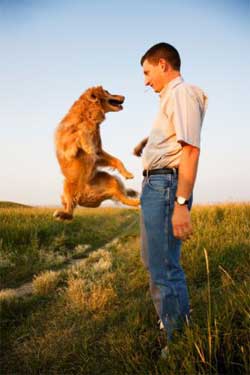
Jumping up deserves a special mention because it is the cause of so much frustration and abuse. Right from the outset, teach your puppy to sit when greeting people. Sitting is the obvious theoretical solution because a dog cannot sit and jump up at the same time. However, it may initially be difficult to teach your dog to sit when greeting people because he is so excited that he doesn't hear what you say. Consequently, you will need to troubleshoot his training.

First practice sits (as described above) in locations where your dog normally greets people, e.g., on-leash outdoors, and especially indoors by the front door. Then invite over ten friends for a dog training party. Today your dog's dinner will be handfed by guests at the front door and by friends on a walk. After eventually getting your dog to sit to greet the first guest, praise your dog and have the guest offer a piece of kibble. Then ask the guest to leave and ring the doorbell again. In fact, repeat front-door greetings until your dog greets the first guest in a mannerly fashion three times in a row. Then repeat the process with the other nine guests. In one training party you will probably practice over a hundred front-door greetings. Then ask your all your guests to leave one at a time and walk round the block. Put your dog on leash and walk around the block in the opposite direction. As you approach each person, instruct your dog to sit. Praise him when he does so and have the person offer a couple of pieces of kibble. After five laps, you will have practiced 50 sidewalk greetings. Now your dog will be ready to sit to greet bona fide guests at home and strangers on the street.

Put Doggy Enthusiasm and Activity on Cue

To be fair to your dog, make sure that she has ample opportunity to let off steam in an acceptable fashion. Sign up for flyball and agility classes. Play fetch with tennis balls and Frisbees and do yo-yo recalls (back and forth between two people) in the park. Formalize "crazy time"—train your dog to jump for bubbles, or play "tag" and chase your dog around the house. And maybe train your dog that it is acceptable to jump up on cue—to give you a welcome-home hug.

To learn more, read Doctor Dunbar's Good Little Dog Book and our HyperDog booklet, available on-line from www.amazon.com.  Reprinted by www.dogstardaily.com with permission of Dr. Ian Dunbar and James & Kenneth Publishers, behavior blueprint by Dr. Ian Dunbar

Tuesday, 27 March 2012

Review - Kathy Sdao "Plenty in life is free"


Kathy Sdao has just launched a book and dvd called "Plenty in life is free" which is an alternative training model to rank/dominance based training models. In the book and dvd she talks about SMART training and how this can be a simple, effective training method.

What is SMART training?

Smart means SEE, MARK and REWARD training. Which means for all the behaviours you wish to reward and increase when you see them, mark them with a word or a click and reward them. This process will increase the behaviours happening more frequently. 

How to use this simple method?
1. Write a list of behaviours that you would like to see my frequently. e.g. dog lying in their bed, dog sitting, dog retrieving balls, 
2. Have some rewards ready, either on your person or at key places around the house.
3. When you see a behaviour you like say "yes" or "good" or click
4. Reward
5. carry on as normal until you see more behaviours you would like to reward and repeat steps 3 and 4.

Who can use this method?
Anyone with any dog. The more observant you are the more frequently the behaviours can be rewarded.

Can I use this method in class?
Yes, SEE, MARK and REWARD training, can be used anywhere, any time. If you are training your dog in class and they do the behaviour or a behaviour near what you would like than you can MARK the behaviour and REWARD. 

Review by Gemma Palmer 


Tuesday, 6 March 2012

Teaching Your Dog To Relax Properly


Relaxing or capturing calmness by Emily Larlham 
This video is a tutorial on how to teach your puppy or dog to be calm. 

It is excellent for teaching dogs to truly relax, teaching a down stay or stay on the bed does not teach the do to relax, it teaches them to stay still. Your dog can still be very tense, stresses or alert even if they are still. Emily uses another dog as a distraction, you can also use other things at a low level which tend to over excite or arouse your dog. Start at a low level of distraction and work up to higher levels as the dog relaxes more and more and as they understand the concept of "settle". 

This can work for dogs who chase shadows, are reactive to people and other dogs, are hyperactive, destructive, stressed or anxious. 


Some dogs need help to learn how to relax. Calmness does not come naturally to some breeds .By reinforcing your dog for being calm, your dog will start to choose calmer behaviors in the future and actually enjoy being calm.

Tips for teaching a Default Settle:
Don’t drop treats if the dog looks up at your hand as you move to give the dog the treat, instead try again later.
Don’t cue the dog “down”. It works better if the dog figures it out on his own and CHOOSES to lay down.
Use high value treats like real meat or cheese for such a wonderful behavior.
Miranda Sasse 

Sunday, 4 March 2012

Why has training not worked for your reactive dog ?

Why has training not worked for your reactive dog ?

There are lots of reasons why our dogs might be slow to respond to training or behavioural modification. By incorporating the tips and training methods found in this blog and from the trainers at Sussex County Dog Training your dogs behaviour can improve. Your daily interactions with your dog and your dogs interactions with the world around them will become as you understand your dog more and are able to better shape your dogs behaviour.
There are several barriers to improving your dog’s behaviour these include:
Using the wrong methods - to improve a behaviour on a permanent basis the root cause of the behaviour must be addressed. If the diagnosis of the cause is incorrect or training is simply addressing the symptoms then the real cause will go unresolved and the behaviour problem will continue. Common incorrect diagnosis often include dominance, guarding the owner and being a "bad" dog. Finding out why the dog is behaving in a certain way is step one, identifying the reward to the dog (the dogs reinforcement for performing the behaviour) is step two. Once we have done this we can look at how to reduce or prevent the dogs reinforcement and use appropriate methods to treat the dogs behaviour based on the root cause (such as fear).

Lack of Practice – our dogs may need more practice to become fluent. Dogs need far more practice than most of us realize to really ‘get it’. And, they need to be trained in a variety of environments with a variety of distractions before they understand how to apply knowledge to any situation, this is called generalization.

Lack of Relevance – our dogs can question the relevance of our requests. We need to help them understand that our requests have meaning and consequences to the dog. This may be that a word that means reward or a behaviour that leads to a consequence.
   
Punishment - our dogs may have been consistently punished when s/he behaved in a set way. A good example of this is when your dog barks at someone we punish the dog with a lead jerk and a firm “NO” – if the dogs outburst was caused by fear we have paired an aversive or negative feeling with the person the dog had barked at –not improving but damaging the dogs expectations of future encounters with people. Even if the dog stopped barking it has probably only suppressed its feelings rather than learnt not to do it in the first place. Be aware that using "training" tools which also punish the dog such as check chains, prong collars, citronella collars and electric or e collars will also suppress the behaviour of a dog without curing it. They can cause further mental and physical damage to the dog and carry a heavy negative moral burden.

Lack of Focus– our dogs may not be focused on us enough to hear our requests. They may be under too much stress, suffering from sensory over load or worried about what is going to happen next.

Lack of Impulse Control – our dogs may not have learned how to control their impulses (or self control) around certain distractions yet. If we can improve impulse control we can often reduce reactivity.

Trouble Shooting Counter Conditioning


This video is from Emily Larlham.  Her site www.dogmantics.com has many more great video's. I have chosen this one today as it trouble shoots problems that people have when using Counter Conditioning. When people tell me that their dog isn't responding to Counter Conditioning (the process of pairing something nice with the appearance of something they previously or currently find unpleasant or scary) I often have to find out why this is. This short video explains many of pitfalls that people will have. Including when the dog hasn't associated that the apperance of the "scary thing" triggers the rewards from the handler. When the dog is over aroused by the rewards, when the dog has incorrectly paired the rewards with the clicks or the marker work "yes".  If you are interested in seeing more of Emily's videos search "Kikopup" on You Tube. 

Happy Watching, Miranda xxx

Saturday, 3 March 2012

“The dog was wagging it’s tail … then it bit me”


Dogs communicate to us all the time using their body language. Unfortunately we don’t always understand what they are trying to tell us, which at times can have huge consequences and may lead to serious injury.
By understanding dog body language and what they are trying to tell us, not only can we avoid accidents from happening, but we can also build a better relationship with our dogs, reduce their stress and improve our training. All of which will lead to a better behaved dog, which is something we all want.

GENERAL POSTURE:

Relaxed dog:
  1. Relaxed muscles so the dog will move smoothly.
  2. The dog’s body weight will be in the centre with equal weight positioned on all 4 paws.
  3. Their ears will be in their natural position – this will depend on the dog – a golden retriever’s will be flopped over and side on whilst a German shepherd’s will be pricked up.
  4. Their tail will be loose and may have a slight gentle wag to it – loose and soft moving from the top of the tail to the tip. It will be in the dog’s natural position again dependant on the dog’s breed. A labrador’s tail might be lower than horizontal whilst a spitz breed may have their flipped up over their back.
  5. They will generally be happy to just look around and won’t be fixated on anything in particular.

Alert dog:
  1. Muscles will be more tense and the dog will move in a more stiff/purposeful manner – think soldier marching compared to some one walking down the street. An extreme example is a dog stalking and then pointing out a bird.
  2. The dog’s body weight will be positioned more forwards with a greater weight on their front 2 paws compared to the back ones. They will also seem bigger than usual because they will be making them selves as tall as possible.
  3. Their ears are likely to be pricked forwards in the direction that they have interest in. This is to help them gain more information about the situation.
  4. The dog’s tail will be stiff with or without a wag. If wagging it will be fast. The tail will be positioned higher than normal so for a Labrador that might be in a horizontal position but some breeds can pull them up higher above their back.
  5. Generally the dog will be fixated on something in particular and will be unlikely to be able to remove their gaze from a specific area – if they have become alert due to a smell or noise then they might be scanning to determine where it has come from.
  6. The dog may have put their hackles up – the hackles are the dog’s fur standing up on end and can start at the top of the dog’s head right down to the tip of their tail.

Nervous dog:
  1. Muscles will be very tense and the dog, if moving, will seem stiff and tentative.
  2. The dog’s body weight will be more backwards with a greater weight on their 2 back paws compared to the front ones. They will also be lower to the ground.
  3. Their ears are likely to be pulled back or even flat against their head.
  4. The dog’s tail will be stiff and with or without a wag. If wagging it will be either very quick or very slow – both types will be stiff with the whole tail moving as one.
  5. The tail will be at a lower position than normal for your dog – mostly this means hanging straight down but a very worried dog may have it tucked right between their legs.
  6. The dog will generally have their gaze fixed on what is making them anxious but if they can’t pinpoint where that is then they may scan the environment.
  7. Their hackles may or may not be up.
  8. They are likely to be showing other stress signals – discussed below.

As you can see from above it is not all plain sailing when it comes to reading your dog. The same posture/movement can mean your dog is either alert or nervous. The key to understanding how your dog is feeling is to look at the whole dog as one. If accompanied by a low body posture and ears flat against the dog’s head, a wagging tail does not always mean happy.
Probably the most important emotion that we must be able to read from our dogs is that of fear or anxiety. Fear is an overwhelming emotion for both humans and dogs, which means that the person/animal may do irrational or unusual things when in that state. These actions could be dangerous for the dog or people around the dog. Fear can cause 4 different reactions, the 4fs, FLIGHT, FIGHT, FREEZE or FIDDLE ABOUT.

FLIGHT:

Avoidance:
  1. Moving away from the scary thing or simply not looking at it. Have you got cross at your dog for not paying attention to you and your dog just ignores you? Your dog is trying to avoid the conflict because he is worried (not because he is stubborn) – try softening your voice and see if your dog suddenly perks up again.
  2. The dog on the left here is a little uncomfortable with being so close to the dog on the right. She could be distracted but this was a series of three photos which all showed her giving off stress signals (see sniffing a licking lips and shaking off)


Bolting:
  1. Running as fast as they can away from what scares them. This can be a very dangerous action if you are out on a walk as they can run across roads (potentially life threatening for your dog and other road users). Your dog is also liable to get lost in this state because they are not in a rational state to remember where you are. Even the dog with the best recall will not respond if they are this scared. If you have a dog that is liable to bolt keep them on a lead for their safety and that of others.
FIGHT:
  • Does your dog lunge at, bark at or show other aggression towards people/dogs or other things? The likely reason is that your dog is fearful of it. Your dog is trying to make itself as big and threatening as it can to make the thing they are scared of go away.
  • If your dog is reacting in this way get your dog out of the situation – if the scary thing gets closer to them they are likely to escalate their attempts to make it go away which could lead to a bite.
  • If your dog does react in this way it is imperative that you do not shout, scold or add anything negative to the situation as this is just going to confirm their fears that the scary thing is dangerous. Instead book yourself in for a behavioural 121 with a trainer who uses positive reinforcement methods. We have 4 experienced trainers here at Sussex County Dog Training who are all willing to help you out – just give the office a call (01243 697 202).
FREEZE:

Inability to move:
  1. The dog becomes fixed in one place and can’t move away or get closer they are literally frozen with fear.
Fixation:
  1. Your dog will not be able to take their eyes off what they are scared of. Making sure it is not getting closer to them in case they need to change their tactic to keep themselves safe.

FIDDLE ABOUT:

These are displacement activities, which your dog might do. They are similar to those we use such as biting our nails, twisting our hair, children sucking their thumbs… A lot of these will show up if you ask your dog to do something either in a harsh way or they are slightly stressed so can’t do as you are asking.

Scratching:
  1. As though they have fleas but you know they don’t.
  2. Chronic stress may lead to a dog harming itself by obsessive licking, scratching or biting of it’s fur – a likely cause if your vet can’t find a medical one.
  3. Remember you dog may just have an itch so read the situation carefully before assuming it is one or the other.
Sniffing:
  1.  Intensely sniffing the ground when they weren’t previously interested in that area.
  2. They may just also be sniffing because there is a good smell again reading their other body language is essential.

Drinking:
  1. You might see this if you bring your dog to training class and you are letting your dog explore but even though they have just had a drink they keep going back to have more.
  2. Remember your dog may just be thirsty especially if you are using salty treats.
A need to hold a toy:
  1. Generally this occurs with gundog breeds – they might find it is comforting to have a large soft item in their mouth – very similar to when children suck their thumbs.
There are two final categories that we need to look at – stress signals (for more information see ‘Calming signals’ by Turid Rugaas) and stress release signals. These final two categories are often found accompanying the other behavioural signals described above but are key things to look out for and can help you determine whether your dog’s behaviour is due to stress/anxiety or something else.

STRESS SIGNALS:

Licking lips – the tongue flicks out quickly and usually repetitively. Your dog may just be cleaning it’s mouth if it has eaten a yummy treat!


Yawning – either partially or full yawns are a sign of stress just as they are in humans. Again there is another explanation – your dog has woken up or is tired.

Panting – this is a different type of panting to that of when your dog is hot.
  1. The face being very tense with the corners of the mouth drawn right back accompanies stress panting.
  2. The tongue usually stays within the set of teeth as apposed to lolling to the side if your dog is hot. The panting is generally very shallow and quick.


Slow movement – your dog does everything in slow motion – this is the dog trying to calm a situation down by not making any sudden movements.

Curving – this is most commonly seen when dogs are going to greet something or try very hard to avoid it.
  1. A polite greeting by dogs is where they both walk towards each other in a curve – they may end up doing a circle around each other before they reach each other’s bottoms for a sniff.
  2. Dogs who are slightly anxious about greeting a person will come in at a angle to you. You can make them more comfortable by turning sideways to them.
Blinking – very slow and large blinks.

Trembling – as though your dog is shivering because they are cold but will usually be accompanied by several other stress signals.

Wide (whale) eye – your dog will show the whites of their eyes and their pupils will be dilated (very large) to enable them to take in as much information as possible.


STRESS RELEASE SIGNALS:

These tend to come when the stress the dog is feeling is removed however they can come during a stressful period as well.

Shaking off – as though they have just been swimming and are shaking water off.


Stretching – as though they have woken up.


If you would like to learn any more about this subject and what your own dog is trying to communicate to you do not hesitate to contact one of the trainers (Jeff, Miranda, Gemma or Anna) here at Sussex County Dog Training. If your dog does any of the behaviours listed above we would love for you to come and see us so we can help you and your dog. We run both classes and 121 sessions for your convenience just give the office a call – 01243 697 202 or email nina@sussexcountydogtraining.co.uk

By Anna Nussey