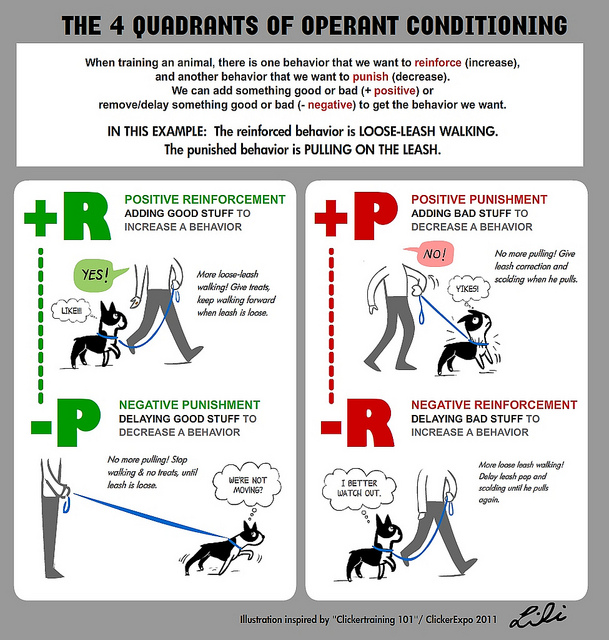
Operant conditioning is a defined set of
principles, developed in the 1930’s by a behavioural scientist called B.F.
Skinner. The theory says we can make things happen, either good or bad, by
choosing behaviours that are either rewarded or punished. We use the 4 methods
Positive Reinforcement, Positive Punishment, Negative Reinforcement and
Negative Punishment and where the dog acts upon the environment. Dogs will not
generalise well, here, and need to be trained in all different environments in
order to fully understand what is required. Once they have learned the
behaviour, in the front room, we then need to train that behaviour in the
garden, then in the park, and so on, until the behaviour has become
generalised. E.g. the dog learns that they can make good things happen by
offering the sitting behaviour. Next the dog needs to learn that those good
things still happen if the sitting behaviour is performed elsewhere. We are
using the Positive reinforcement quadrant here to teach the dog that sit is the
behaviour we want, and we want it, to cue, in all environments.
With Classical Conditioning, we are not
necessarily looking to train a behaviour, yet looking for an emotional response
from our dog.Often our dogs have learnt
these responses from a single incident, and thus these become generalised very
quickly. Behaviours that involve a strong emotional response where the
environment acts upon the dog are classically conditioned. i.e. fear of thunder
and lightning or the fear of children after an incident involving a child
pulling his/her ears. Next time he/she see’s a child, they can generalise very
quickly and have an emotional response of fear towards children. On the other
hand, as with Pavlov’s dogs, the emotional response to the bell ringing was to
salivate at the prospect of food, and dogs who have had pleasant experiences
with children, soon generalise that all children are nice, and their emotional
response is one of happy thoughts and not fear.
When looking to apply operant conditioning or
classical conditioning when dealing with a dog’s problem, first we must define
the problem. Problems are often defined as problems for the owners and not for
the dogs. A dog that loves to greet us by jumping up, may have been rewarded
for this by a cuddle here and there, and yet now it has become a problem,
especially as the dog has grown bigger and stronger. Here we would teach the
dog a new behaviour (operant conditioning) as jumping up is not necessarily an
emotional response (classically conditioned) but a learnt one, probably through
reward.
We would in this case use positive reinforcement,
and maybe, negative punishment to change the unwanted behaviour of jumping up
to the desired one of sitting when you greet me.
When the dog jumps up we can turn away (negative
punishment) and when the dog puts all 4 feet on the floor, we reward that
behaviour (positive reinforcement) As we continue to do this exercise, the
unwanted behaviour will extinguish, and the desired behaviour increase.
Alternatively, if we do not want to use negative
punishment here, we can ask the dog for an incompatible behaviour to jumping up
(desensitisation of incompatible behaviours), a sit, and reward this desired
behaviour. Again the unwanted behaviour will eventually extinguish and the
desired behaviour increase.
If we were to encounter a dog who would bark at
another dog, due to an emotional response of fear (classically conditioned), we
could look to change the dogs emotional response using classical conditioning,
or a technique called counter conditioning.
For dogs to learn, we must ensure that they are in
the right state of mind, and a dog that is so fearful may not be able to learn,
as its emotions are such that it is not cognitive to learning. This happens if
we subject the dog to too much of the stimuli that causes the fear in the first
place. Some trainers will flood the dog here in an attempt to prove to the dog
that there is nothing to fear and subsequently change the dogs emotional
response and learn to be happier in the presence of other dogs. This method, in
my opinion, can also cause a dog to shut down and not be able to learn that
other dogs are nothing to be fearful of, or worse still lead to some aggression
towards the other dogs. If we ensure that the dog is in a clam state before we
introduce the stimuli, then this helps towards learning. We need to change the
dogs emotional response from fear by adding something nice in the presence of
the stimuli. We can use high quality treats to feed the dog, ensuring that our
dog is not overly stressed at each stage. We will keep the stimuli(other dog)
at a distance, where our dog is happily eating the treats, thus now pairing the
presence of another dog with something nice. We can move the stimuli closer
over a period of time or over different sessions, as our dog becomes more at
ease, subsequently classically conditioning the dog to enjoy the presence of
other dogs.
Positive
Reinforcement – We
increase the chance of a desired behaviour happening again by rewarding it. The
dog soon learns that in order to earn his reward, he just has to repeat that
desired behaviour.
E.g. when the dog sits in front of us, we say
“yes” in a happy tone and reward that with a treat. Marking the behaviour with
a “yes” and rewarding the dog with a treat will increase the chances of that
behaviour happening again. This is a strong way to enhance the
bond/relationship with your dog whilst training. Rewarding all the desired
behaviours is a great way to help you and your dog feel great about training,
and increases the desire to train and learn new things. When we use positive
reinforcement dogs learn to think more and look to offer us behaviours in order
to be rewarded. This gives the dog confidence in the learning program.
Positive
Punishment – We
decrease the chance of an undesirable behaviour happening again by adding a
punishment that the dog dislikes (an aversive). The dog learns that if he
repeats this behaviour, it may be paired with an aversive.
E.g. the dog Jumps up at us, so we smack it on the
end of the nose!! The dog learns that if he jumps up at us, this may be paired
with a smack on the nose, and so decides against jumping up.
This method of training, will eventually break
down the bond/relationship between dog and handler and if used regularly will
not only stop the dog enjoying training, but may, if the dog becomes fearful
lead to aggression. Dogs may become tolerant of this method, making it
ineffective in changing the behaviour, yet still affecting your relationship.
Unlike positive reinforcement, dogs here learn not to trust their handler, and
look to suppress behaviours in case a punishment was to follow.
Negative
Reinforcement – The
dog’s behaviour makes something undesirable go away.
E.g. in order to increase the chances of a sit, we
lift the lead, choking the dog, and remove when sitting. The dog will sit
because he doesn’t like the choking when lifting the lead. Like the punishment
method dogs just want bad stuff to go away. They will however pair you with the
“bad Stuff” and this will break down the bond/relationship you have with them.
Negative
Punishment – We
decrease the chances of an undesirable behaviour happening again by removing a
motivator (something the dog wants)
E.g. the dog jumps up to get our attention
(something the dog wants), so we turn our back (removing ourselves) in order to
reduce the behaviour happening again. This type of punishment is a non-force
method and can include removal of a treat, a toy, a person or even a privilege.
This is a non-aversive method of providing a consequence for an unwanted
behaviour. This type of punishment is best paired with positive reinforcement,
which quickly teaches the dog rights and wrongs. In the example above, if we
rewarded the sit on the floor with a treat or our attention (positive
reinforcement) then we would not only look to extinguish the unwanted jumping
up, but also increase the chances of the sit on the floor.
Because they find not coming back more rewarding than being
with their owners. If our dogs loved being with us that much they would not
need to be taught a recall as they would always want to be in our company.
Often there is a lack of understanding about the learning
theory of dogs. We often accidentally reward the dog for not coming back when
called and then we punish the dog when they do come back. Let me explain...
When a dog is rewarded for a particular behaviour it makes him more likely to
perform that behaviour again. When a dog is punished for a particular behaviour
it makes him less likely to perform that behaviour again. For a more detailed
explanation please see the attached sheet on operant learning (this is the way
in which all animals learn, dolphins to gorillas and of course dogs.)
Here is a list of some things that could be rewarding for a
dog, try listing what your dog enjoys. These are classified as rewards or
reinforcers.
Food, discarded wrappers, bins, chasing joggers, toys,
sticks, smelling a gate post or when another dog has urinated, watching –
barking at or chasing cyclists, social interactions with people or dogs,
sniffing poo, rolling in poo, rolling on dead animals, eating poo or dead
animals, chasing rabbits or deer, watching children playing, joining children
playing, chasing children playing, playing with you, watching people play
football or ball games, playing ball games, playing with other dogs, sniffing
another dogs bottom, chasing seagulls, shredding an empty box, stealing items
of clothing or items belonging to others, soft toys, pigs ears, stuffed kongs,
treat balls, tennis balls, squeaky toys, chasing leaves, barking at squirrels,
running really really fast, etc
Here is a list of some things that a dog may perceive to be
a punishment. In dog training a punishment is anything a dog doesn’t like.
Verbal corrections, physical corrections, anything that
startles or scares the dog, removing them from something they value (any
reward), taking anything they value away.
As you can see from the extensive list of rewards above, it
is very easy for your dog to be rewarded away from you. It is very easy for
your dog to be rewarded for NOT coming to you . Many “rewards” are easy for
your dog to obtain without you. They can obtain the reward with little or no
work and many of these rewards are also (in your dogs eyes) very high in value.
With this in mind it is easy to understand why your dog would prefer to be off
the lead and won’t be coming back until the rewards are extinguished or your
dog is too tired to enjoy them.
How we accidentally punish our dogs for coming back.
Using punishments in dog training is ineffective and
detrimental because dogs learn by association. When we punish a dog we also
need to be mindful of what we are punishing. For Example:
·We shout at the dog for not coming back when he
is playing with some children – is the dog being punished for? Not coming back
or for playing with children? The dog will think twice about playing with
children if this is repeated regularly (or even just the once if you have a
sensitive dog!)? He may even decide children are bad and start to bark when he
sees them.
·We roughly grab the dog’s collar and curse him
when we finally catch him after an hour of trying to get him to come back, what
is the dog being punished for? Allowing himself to be caught or for being
naughty and not coming back? Next time will he try harder not to be caught
because he got punished at the same time the hand touched his collar?
·We call the dog every time dogs appear because
he loves playing with other dogs and won’t come back. We are amazed when he
actually comes to us so we put him on a lead so he cannot run off to see the
other dogs which have appeared. Is he being punished for coming back? Next time
when the dog is deciding between other dogs and his owner which will he pick? If
he goes back to his owner he loses the reward of playing with other dogs.
Punishing the dog is ineffective and can create much bigger
behavioural problems. Preventing the dog being rewarded by external reinforcers
is far more successful. This makes the process of teaching a conditioned recall
command much easier. When we teach the recall we need the dog to be successful and
thus receive rewards from the owner for the correct behaviour. So preventing
bad behaviour – by either not calling the dog or by having a long line or
extender lead improves the chance of success.
Other barriers to
recall training
Practise -
Not putting in enough good regular practise
Bad Puppy Training- Not training and
showing the puppy how wonderful you are when they believed you actually might
be that great. Teaching your puppy to stick with you and how great you are
should have been done with thousands of repetitions from 8 weeks old. If you
have waited till your dog is not responding it will be hard work.
Too many failed attempts- Calling the dog all the time and
the dog not coming (this teaches the dog that “here boy” actually means evade
capture and run off! The ratio of
success to fail must be almost 90% to 100% in favour of success. This is
because the rewards for ignoring the recall and not coming back are so high.
Come = bad stuff- We
pair calling the dog with other ‘bad’ activities grooming, nail clip, putting
out in the rain, frontline, car journey, to be put in the kitchen because you
are going out, to be put in a crate, things your dog doesn’t love or like.
Being predictable-
Allowing your dog to predict the reward you are going to give them so they can
choose you’re “treat/reward” or the other external reward (other dogs, rabbits,
poo etc)
Changing the words- We keep changing our
recall command or we don’t actually have one. Using the dogs name is difficult
because it is used in many other contexts, using a word is hard to keep emotion
out of it and keep everyone saying the word in the same way. Whistles are great
or short commands/noise. Make sure you are also keeping your whistle command
the same too.
Repetitions - Conditioning can triumph
over distractions even when the rewards are not as good, good examples are that
everyone looks at the clock when we wake or flushes the loo when they have
finished, those are conditioned responses. Teaching a conditioned recall is
possible for most dogs.
Good Rewards-
High quality rewards are so important and they should be kept high quality by
limiting them to training, if you give your dog high value treats at home why
would he want them when he is out – he can get those at home where there are no
other dogs or squirrels. Varying the rewards a lot and always having a good
mixture of different types of reward is also important. Examples of different
food rewards: chicken, liver, carrot, kibble, shop brought treats, liver cake,
tuna cake, chopped meat balls, frankfurter/ hotdog sausage, etc. All rewards
should be free from colours, additives, sugar and preservatives. Once we have
taught the new behaviour (recall) we will mainly use the dogs dinner but varied
and high quality treats help to teach and ingrain a behaviour.
This is an
excellent article on the use of food in training dogs. I would urge anyone
reading this who has questions or misgivings about using food in training to
read this article:
Other Types of Good rewards- If your dog loves a tennis ball there is
nothing stopping you using a tennis ball. If your dog loves squeaky toys use
them. But remember to keep them special by limiting access to them to times
when you want the dog to respond. Also
try to keep it varied, different types of the same toy or reward type and
different amounts of intensity of play or fuss, different amounts of time
allowed with the rewarding object or person etc.
Rewards delivered correctly - Rewards should also be given using a
system a bit like “performance related pay”, this means never giving the dog a
regular pattern of treats or types. We then reward the dogs best behaviours
withthe better rewards, but never
allowing the dog to predict what really great reward they are going to get.
An example
of a variable rewards:
“Sit” – one
high quality reward - “go play”
“Sit” – three
low quality rewards – “go play”
“Sit” – two
medium quality rewards - “go play”
“Sit” – praise
only – “go play”
“Sit” – Really
enjoyable game of tug -“go play”
“Sit” –one
medium quality reward -“go play”
“Sit” –praise
only -“go play”
“Sit” - one
very high quality or novel reward -“go play”
“Sit” –praise
only -“go play”
“Sit” - throw
of the tennis ball -“go play”
“Sit” – (The
Dog did it immediately over 10 meters away) – Jackpot of many different
rewards-“go play”
“Sit”
–Praise only -“go play”
Marking behaviours
If we do
not tell the dog when they are getting it right, how will they know what they
are receiving the reward for? Not telling the dog when they are getting it
right plays a massive part in preventing a dog succeeding, if they don’t know
what behaviours will get them a reward from you, then they will go and seek
reward from other avenues.
By using a
marking word or sound whenever the dog does part of or a whole behaviour you
would like you must be able to tell the dog that was what you wanted. If you
are consistent with the way in which you do this by always saying a specific
word, type of praise or making a specific noise just before you reward the dog
they will start to associate the behaviour they were doing at the precise time
they heard the word or sound with the reward and try to repeat that behaviour
to earn another reward.
Good
Examples of Markers: A clicker
sound, a word like “yes”, “good”, “great”. Words like “good boy” can be a bit
long and people tend to often use them and not always reward. You must always
reward even if it is only using extra praise after the marker. Food, toys and
life rewards are better though. Life rewards include many of the things stated
at the start of these notes (page one).
This of
course only works if the reward you are offering after your marker is actually
rewarding to the dog and if the dog doesn’t find your “prize” rewarding then it
isn’t actually a reward to your dog at all.
For
instance: The dog who is a very fussy eater and is not food orientated but
loves to chase things, is unlikely to find a treat rewarding, especially if it
is low quality and not interesting and novel. For that do the opportunity to
chase a ball or even the owner is more likely to effectively reward the dog.
Thus the dog will be more motivated in the future. However remember we can
train the dog to enjoy food treats more, just as we can teach a food motivated
dog to enjoy toys more.
Recall Games and Foundation Exercises
“5 minutes
of play a day” – if life with your dog can be a bit of a battle changing your
outlook on the relationship you have with your dog will make a huge difference.
Put aside five minutes every day to simply play with your dog. Try to start
doing this on your walks if you can. Get your dog loving to play with you at
home (do it EVERY DAY) then try to spread your five minutes over a whole walk –
five sets of one minute play. The more your dog enjoys playing with you the
more rewarding you are to your dog. If you want to do more do more short
sessions but do not extend past five minutes at a time. The play must be very
exciting and make your dog thrilled at the prospect and very energised!
Make sure
you play different and interesting games. You want the dog to be excited and
bouncy about the prospect of spending time with you playing. This is different
to obsessively playing ball, (which is great, but don’t do it all the time or
you become predictable) the games should be focused on your interaction with
your dog.
This is a
great video about teaching Tug:
Here are a few videos on Go Wild and Freeze or variations on this fun game to play with
your dogs:
Video for
teaching fetch (but be careful about playing with sticks as the trainer does in
this video, they can be very dangerous to dogs if they run on to them. Use toys
or rags or even a stuffed Kong on a long string rather than sticks) I still use this video as with the exception of the stick i think it is great.
Other recall
games:
I love this video so much as the dogs and the humans are having wonderful fun. There is no end to the fun you can have with recall - just try and think up great ways to interact with your dog on a walk. You must remain more interesting than the environment.
Remember if
any of these are off lead and you do not have a recall with your dog you will
be practising on lead/ with a long line attached or in your garden.
FOUNDATION
EXERCISES
Gotcha –
Collar Grabs
Teaching
your dog that they like you catching them and taking them by the collar is so
important. This is normally the gesture (reaching for the collar) that makes
the dog start evading you. In Short: reward your dog as you take them by the
collar. This video starts with small dog tips and moves on to large dogs.
Find it game
The find the
treat game reinforces returning to you and makes it easy to teach your recall
command. It is very easy to get in lots of repetitions. In Short: call your dog
and when they come close enough to touch you or allow you to collar grab –
throw the treat away to the side and get them to chase and hunt for it using
the command “find it”.
A similar game is the find it through your legs game:
Ping Pong
Dinner game
The Ping
Pong Dinner game gets your dog to run between humans receiving lots of yummy
kibble. A great way to use the dogs dinner to reinforce how great it is for the
dog just being around you, how great the recall command is and how great
approaching people is when they are calling is. One person calls at a time –
only that person rewards the dog, the rest are silent. When the dog has had
their rewards from that person the next calls, and so on and so forth.
Follow me
Running away
from your dog when they wander from you and playing the opposites game where
catching up with you is really rewarding and wandering off makes you run away.
Great use of a dogs chase drive and desire to be part of a group.
Restrain and
run
Building up
anticipation in the dog, he or she is held back whilst the owner runs off being
suitably exciting. Then the owner/handler calls, the dogs are released and then
rewarded for catching them up.
Run and Hide
The same as
the above video but done where there are visual barriers. This increases the
dogs desire to see where their owner has gone. This can also be done by
distracting the dog with a treat or thrown reward and then running off to hide
when the dog is not watching, or by someone holding them back.
Other times
you can achieve other practise opportunities: Circumstantial recalls – for
dinner, for lead, for when you come in, when you come in from another room or
when you come down stairs in the morning.
A NOTE ON
SITTING –Don’t ask for a sit if your dog tends to hesitate or be selective
about this command.We want to reward
the recall not the sit. If you get a ‘sit-struggle’ the dog has an unpleasant
association with coming when called. A ‘sit struggle’ is where the dog doesn’t
sit so you have to insist on it (because follow through and consistency is
everything in dog training) and the moment of the recall is lost and the memory
of “sit, Sit, Sit , SIT!!......Oh good dog...finally” is what is left with you
and perhaps with your dog.
Later on,
when your dog is loving coming to you, we can add the sit in.
Using a long or Light Line
By now we
will be practising places where there are mild distractions, at this point we
will add a management tool like a long line, house line or extender lead.
Remember if using an extender lead the dog will feel like it is on a lead much
more than if it were on a long line or house line as there is a constant pull
on the dog’s collar.
Once your
dog is achieving its recalls more than 90% of the time with the mild
distractions you could attempt to practise with all levels of distraction.
Proof your dogs recall around every available distraction until you are super
confident of your dogs response before you start to get rid of the lead.
How to use
the long line effectively and safely – this will be covered on the day but
please watch the videos below.
VIDEO NEEDED - sorry guys I'm working on it!
Removing the long line or lead
Sometimes it
will be possible to simply drop the long line but leave it trailing behind the
dog. Other times you will be able to be long line free because you may have a
chance to practise in a fenced field or friend’s garden, remember you only
start to fade the long line when you have a 90% successful recall even with
major distractions in many different outdoor environments.This means you never need to use the long
line to ever pull on the dog. You should try to start this way, avoiding the
temptation to tug at the dog to get his attention or get a recall.
Rather than
simply take the long line off, when the dog can recall around any distraction,
in any environment 90% of the time, we start to shorten the long line and fade
it gradually rather than simply take it off. The dog will often realise that it
is the line which reinforces the behaviour. If your dog makes the wrong choice and
knows the line is no longer there the dog may decide to not come back. If the
dog does not notice the line getting shorter and lighter you are less lightly
to have this realisation from the dog. You do this by just chopping bits off
your rope or line a little at a time.
A successful
recall is when you have called the dog once and they have responded straight
away and no lead or further command or reminder is required. The dog doing it
all on their own and straight away and ENJOYING their new recall games.
Try to think
of every scenario where you dog will require proofing. When attempting recalls
with distractions, always build up the distractions slowly. Go from easy
distractions you are sure your dog can achieve a recall around, then make it
slowly harder.
A big list
of possible distractions to inspire you.
A human
playing with toy quietly a large distance away
A dropped
boring item as the dog walks/runs passed
A dropped
item less boring
A dropped
item interesting
A dropped
item smelling and fun looking
A dropped
item containing food which the dog can’t access
A human
playing with a toy in one place but with more vigour
A human
playing with a toy with vigour closer to the dog
A human
playing with a toy loudly with vigour
A human
playing with a toy walking around quietly
A human
playing with a toy walking around and talking loudly
A human
playing with a toy whilst walking, talking loudly and with vigour
A human
playing a fast game with a toy quietly
A human
playing a fast game with a toy loudly and with vigour
A dropped
food item that smells really good
A dropped
food wrapper that smells good and moves in the wind
A fake dog
on a lead
A quiet dog
sitting still on a lead in the distance
A quiet dog
walking on a lead in the distance
A quiet dog
walking on a lead – closer but behind a fence
A quiet dog
walking on a lead quite close
A quiet dog
running in the distance
A quiet dog
running behind a fence
A quiet dog
running closer to your dog
A bunny
sitting miles away in a field not moving
A bunny
hopping about miles away in a field
A bunny
running about miles away in a field
The same
bunny as above but 50 metres closer. 1st sitting, then hopping, then
running
The same
bunny as above but 100 metres closer. 1st sitting, then hopping,
then running
The same
bunny as above but 500 metres closer. 1st sitting, then hopping,
then running
The same
bunny as above but 1000 metres closer. 1st sitting, then hopping,
then running
A slightly
more bouncy dog sitting in the distance on the lead
A slightly
more bouncy dog walking on a lead in the distance
A slightly
more bouncy dog walking on a lead – closer but behind a fence
A slightly
more bouncy dog walking on a lead quite close
A slightly
more bouncy dog running in the distance
A slightly
more bouncy dog running behind a fence
A slightly
more bouncy dog running closer to your dog
A very
playful and bouncy dog sitting in the distance on the lead (if possible this
type of dog likes to be active!)
A very
playful and bouncy dog walking on a lead in the distance
A very
playful and bouncy dog walking on a lead – closer but behind a fence
A very
playful and bouncy dog walking on a lead quite close
A very
playful and bouncy dog running in the distance
A very
playful and bouncy dog running behind a fence
A very
playful and bouncy dog running closer to your dog
The same as
above but with the dog playing with a toy – start quiet and far away and get
harder
The same as
above but with the dog being fed treats – start quieter and far away and get
harder
You may wish
to do examples of the above with wildlife, sheep, picnics, poo, bikes, joggers
anything you would rather the dog ignored and came to you instead.
Now repeat
all the above from scratch in a new environment. If you taught this at your
local park, now try the beach or the woods or the fields. Remember to go back
to scratch each new place you go, your dog is very situational and will not
easily transfer those skills. Once they have learnt to come away from the
hardest distractions in two or three places then transferring the skills will
be quicker and easier but training will still be required if you want your dog
to be reliable.
Advanced
The Premack Principle
For a great
video on the Premack Principle please go to:
David
Premack developed the Premack
Principle. It puts forth “[t]he observation that high-probability behaviour
reinforces low-probability behaviour.” Essentially it means this: “Eat your
vegetables and you can have dessert.” To make this a bit easier to understand
in terms of dog training, high-probability behaviours are what the dog wants;
low-probability behaviours are what you want. In terms of recall the behaviour
we want is for the dog to return so we can hold on to the dog for whatever
reason we need to.
Choosing the high probability
behaviours – what the dog wants.
Be
sure to pick only those things that you would want to use as reinforcers later.
Reinforcers in this case are the behaviour the dog wants – the high probability
behaviours .Sock stealing, paper eating, garbage raiding, poop eating,
furniture rearranging or chewing, and general behaviours you don't want don't
count and shouldn't be on this list. For recall try to use things which are
socially acceptable like saying hello to another dog or going to jump in a
puddle. Be creative and watch your dog. He'll tell you what he wants. It may
change from day to day, hour to hour, and even minute to minute. And that's
okay—it will give you more reinforcers to choose from.
How
will we know what the dog wants? Watch him carefully and write down what he
enjoys most. Don't think you'll remember it all without writing it down,
because you won't. See the list on page one for more ideas as well.
When the dog does what we want, we can now (where
appropriate) reward him with what he wants. Making doing the behaviour we would
prefer more likely as it is a path for the dog towards his own desires.
Here is a great article on using the premack
principle and recall:
In training
we will return to the very mild distractions in a very easy environment. Now
when the dog does his recall he will get the reward from you and then he will
also get to investigate the distraction afterwards. This isn’t done every time
but regularly. Build up from mild distractions to hard distractions.
More Examples
of Premack:
Last Few Tips
We are
trying to create an automatic behaviour, getting a behaviour that the dog does
without thinking about it. A habit of behaviour which, when regularly
reinforced and trained, will remain with the dog for a lifetime.
When it
all goes wrong (this will happen to even the best handlers!)
Remember
interrupting the repetitions and training session to tell the dog off will slow
training and disturb the pattern of learning. It can also confuse the dog and
will make you both more stressed. Stop
training for a while when it all goes wrong, and return to it later.Do this without telling the dog off. Stopping the training and fun with yourself
will be a punishment on its own as long as your dog is finding you very
motivating and enjoyable. By simply stopping rather than saying “NO” or “bad
dog” etc, you won’t damage the relationship between you and the dog, or put the
dogs training back a step, you will simply be saying that bad behaviour stops
fun happening.
From this we
can see that getting things wrong in training is as de-motivating for the dog
as it can be for you and removes the fun and excitement from training. You can only get recall wrong if you have
rushed the process or come up against a distraction you haven’t trained
with.You will only get moments where it
all goes wrong once you start to fade the long line, or you are in a very
distracting environment on a long line before the dog is able to cope.
Your dog
standing or pulling at the end of the line and totally ignoring you is not a
huge failure – it means you are trying to walk your dog somewhere where there
are too many distractions or your dog needed to be exercised in the garden
before you went out for your walk. It
could be you haven’t done enough foundation exercises or recall games.
It could be
that your dog is not motivated by your rewards enough. Try hand feeding your
dog all his food, if he refuses it he doesn’t get any food (no none at all!)
until he will happily be hand fed all his food inside. Next stage is for our
‘Fussy Fido’ to be hand fed all his food in the garden, next stage is for him
to be hand fed all his meals on his walks. No food at home at all.
The Real
World
When you
start training again make it easier so your dog always gets it right. Never
give your dog the chance to go wrong by using the long line, normal lead or
extender lead or fences. Don’t have your dog off lead unless you know it will
come when you call – this is an example of setting the dog up to fail. If you
forget and let the dog off DO NOT CALL THE DOG just wait till the dog
approaches you or another human and praise and connect your long line back on.
If you
really feel you must let your dog off for some reason even though you know that
he is not fully trained make sure you have the time to wait for him to return
without calling (as calling when your dog doesn’t respond just teaches him he
can ignore you) – do not get stressed if this takes a long time as you made the
decision to let the dog off the lead.Also remember the more self reward the dog has by having fun without you
the less likely your dog is to return to you, he will wait till the opportunity
for fun has gone first – then come back. If, of course, your dog believes you
ARE the most fun he could ever have you will never have this issue. It is a realistic observation that calling
your dog away from playing with other dogs (or any rewarding or reinforcing
experience) is as much a punishment as stopping the dogs training fun when he starts
to misbehave or taking a teenagers mobile phone away from them when they
misbehave.
Remember
that there are no quick fixes and it will take 1000’s of successful repetitions
and years
of training to achieve a perfect (or near perfect) recall. Not just weeks or months,
if you have a recall “problem” now it will be a long time with daily practice
until it is solved. Don’t forget the daily play and daily practice.
NEVER, EVER
USE VERBAL OR PHYSICAL PUNISHMENT WITH YOUR DOG, especially when he comes to
you or you wait for him to come to you.I.e.”Fido Fido? Did you do this? Have you been
a bad boy? Come here! Did you do this?” – will Fido be likely to come next time
you call his name now you have paired it with a punishment?
If you use a
cross tone (or worse) with your dog to try and solve behaviour please note this will only suppress the behaviour or
interrupt it not get rid of it, so be prepared for it to resurface again. Remember it will also damage your relationship
– after all, who wants to return to the nagging human when birds are there to
be chased, dogs to be played with and bushes and trees to be investigated.
The more
positive and fun relationship you have with your dog, the more likely you are
to achieve a recall in the end.
For more
information on how to stop bad behaviours for good, please talk to Miranda or
Jeff about your issue.Be it minor or
major, we are here to help.
This video is from Emily Larlham. Her site www.dogmantics.com has many more great video's. I have chosen this one today as it trouble shoots problems that people have when using Counter Conditioning. When people tell me that their dog isn't responding to Counter Conditioning (the process of pairing something nice with the appearance of something they previously or currently find unpleasant or scary) I often have to find out why this is. This short video explains many of pitfalls that people will have. Including when the dog hasn't associated that the apperance of the "scary thing" triggers the rewards from the handler. When the dog is over aroused by the rewards, when the dog has incorrectly paired the rewards with the clicks or the marker work "yes". If you are interested in seeing more of Emily's videos search "Kikopup" on You Tube.


.jpg)
.jpg)